2026-05-30
SARB Hikes Prime Rate to 10.50%: What It Means for Your Home Loan
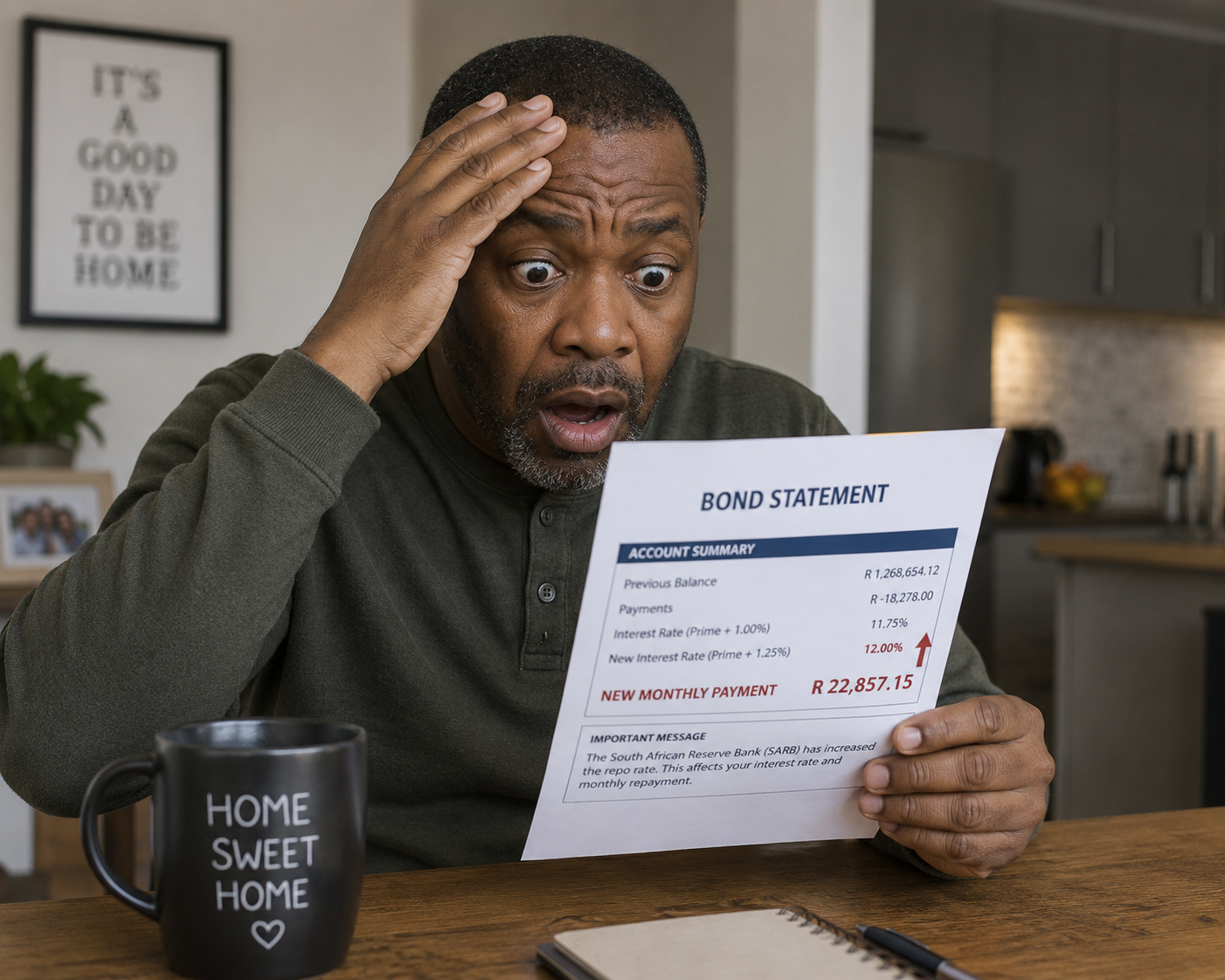
On 29 May 2026, the South African Reserve Bank's Monetary Policy Committee (MPC) voted to raise the repo rate by 25 basis points to 7.00%. The prime lending rate — the rate your bank uses as the base for your home loan — rose with it, moving from 10.25% to 10.50%.
Four of the six MPC members voted for the increase. Two preferred to hold. The deciding factor: inflation climbed from 3.1% in March to 4.0% in April, driven by rising energy costs and global shocks tied to the Middle East situation. The SARB wants to prevent these price pressures from becoming entrenched before they reach their 3% midpoint target.
What just changed — in numbers
| Rate | Before (Nov 2025) | After (May 2026) | Change |
|---|---|---|---|
| Repo rate | 6.75% | 7.00% | +0.25% |
| Prime lending rate | 10.25% | 10.50% | +0.25% |
| Typical home loan rate (prime + 0.5%) | 10.75% | 11.00% | +0.25% |
The rate path: context matters
To understand where we are, it helps to see how aggressively the SARB hiked during the 2022–2023 inflation cycle, how much ground was recovered in 2024–2025, and where the May 2026 hike leaves us.
The story: the SARB hiked aggressively to tame post-pandemic inflation, then cut steadily through 2024 and into 2025 as inflation eased. The May 2026 hike reverses some of that relief — a sign that fresh global shocks are threatening the SARB's hard-won progress.
Impact on existing bond holders
If you already have a home loan, your repayment changes automatically — usually from your next debit order. Variable-rate bonds (the standard in South Africa) move in lockstep with prime.
The table below shows how much more you'll pay per month on a 20-year bond at the new rate (prime + 0.5% = 11.00%) versus the old rate (10.75%). Estimates are rounded to the nearest rand.
| Bond balance | Monthly at 10.75% | Monthly at 11.00% | Increase/month | Increase/year |
|---|---|---|---|---|
| R500 000 | R5 077 | R5 161 | +R84 | +R1 008 |
| R1 000 000 | R10 154 | R10 322 | +R168 | +R2 016 |
| R1 500 000 | R15 231 | R15 483 | +R252 | +R3 024 |
| R2 000 000 | R20 308 | R20 644 | +R336 | +R4 032 |
Note: These figures assume you are at the start of a 20-year term and your rate is prime + 0.5%. Your actual increase depends on your outstanding balance, remaining term, and your specific margin above prime. Use the repayment calculator to get your exact figure.
The compounding effect: total interest paid
A rate increase doesn't just affect your monthly instalment — it lifts the total interest cost over the entire life of the loan. On a R1,000,000 bond over 20 years:
- At 10.75%: total repaid ≈ R2,437,000 (R1,437,000 interest)
- At 11.00%: total repaid ≈ R2,477,000 (R1,477,000 interest)
- Additional interest cost over 20 years: ≈ R40,000
That R168/month increase in your debit order quietly translates to R40,000 more paid to the bank over the full term — on a R1m bond alone.
Impact on new bond applicants
If you haven't bought yet, the higher rate affects two things: what you can afford and what the bank will lend you.
Banks assess affordability under the National Credit Act (NCA) — typically limiting your bond repayment to roughly 30% of your net monthly income. Because each rand of bond now costs more per month to service, the maximum bond the bank will approve at the same income is slightly lower.
| Net monthly income | Max bond at 10.75% | Max bond at 11.00% | Reduction |
|---|---|---|---|
| R15 000 | ≈ R443 000 | ≈ R436 000 | −R7 000 |
| R25 000 | ≈ R739 000 | ≈ R727 000 | −R12 000 |
| R40 000 | ≈ R1 182 000 | ≈ R1 163 000 | −R19 000 |
| R60 000 | ≈ R1 774 000 | ≈ R1 745 000 | −R29 000 |
The reduction looks modest in percentage terms, but for buyers already on the edge of qualifying for a specific property, it can push the target home out of reach. A deposit becomes more important — every rand of deposit directly reduces the bond amount the bank needs to approve.
What should you do?
If you already have a bond
1. Don't panic — absorb the increase if you can. R168/month on a R1m bond is real money, but it's manageable for most households if budget adjustments are made. Review your debit order date and check your account has the buffer.
2. Pay in extra when possible. Making even one additional payment per year of roughly your monthly instalment amount knocks years off your bond term. At the new rate, every extra rand works harder because the interest saving compounds forward.
3. Consider a fixed rate — but do the maths. Banks offer fixed-rate options, typically above the current variable rate, to protect you from further hikes. If you believe rates will rise significantly further, it may be worth the premium. If rates fall, you pay more than necessary for the certainty. Talk to your bank or a bond originator.
4. Avoid extending your term to reduce the payment. Banks sometimes offer to extend your loan term to 25 or 30 years to lower the monthly bite. This feels like relief but dramatically increases your total interest cost. It should be a last resort.
If you're still buying
1. Recalculate your affordability at the new rate. Use the calculator below with 11.00% (prime + 0.5%) as your base. If you were borderline qualifying, re-run the numbers now.
2. A larger deposit solves two problems. It reduces the bond amount the bank needs to approve (helping you qualify) and lowers the monthly repayment from day one. Even a 5–10% deposit makes a meaningful difference.
3. Apply through a bond originator. Services like ooba or BetterBond submit your application to multiple banks simultaneously at no cost. Banks compete for your business, and you may negotiate a margin below prime that partially offsets the rate increase.
4. Watch for the rate outlook. The SARB projects inflation returning to the 3% midpoint in 2028. If that path holds, further rate cuts are possible in 2027 onward — but the timing is uncertain. Don't plan your affordability around a rate that hasn't happened yet.
The SARB's reasoning
The MPC stated that "overlapping shocks" — energy price spikes tied to global geopolitics and currency pressure — risked driving inflation expectations higher. Once inflation expectations become unanchored, they become self-fulfilling and harder to reverse. The 25bps hike is a pre-emptive signal that the SARB will not allow the hard-won disinflationary progress of 2024–2025 to unwind.
The SARB now projects:
- Headline inflation: 4.4% average in 2026, down to 3.7% in 2027, and returning to the 3.0% midpoint in 2028
- Assuming this path holds, rate cuts could resume once inflation is sustainably below 4.5%
For home buyers, that means the next 12–18 months are likely to remain at elevated rates before any meaningful relief arrives.
See how the new rate affects your specific bond
The calculators have been updated to reflect the current prime rate of 10.50%. Enter your bond amount or income to see your repayments at today's rate.